
This content is for educational purposes only and does not constitute legal or investment advice. For your specific situation, consult a licensed immigration attorney and FINRA-registered financial advisor.
International students invest substantial time, capital and assume a lot of risk when they decide to study in the United States. This journey creates a unique and intense form of stress that follows the international student for years. There are over 1.1 million international students currently enrolled in the U.S. and all of them will consider the transition from the F-1 student visa to post graduation employment via Optional Practical Training (OPT). Use our OPT Calculator to understand your timeline. This is a high stakes gamble and only gets worse when they have to consider the notoriously unpredictable H-1B visa lottery. This systemic risk threatens to nullify years of academic and financial investment. The solution is the EB-5 immigrant investor program which is often overlooked as a strategic alternative that students should consider before it's too late.
The F-1/OPT Treadmill and the H-1B Dart Throw
The primary source of stress for international students is the lack of a predictable path to permanent residency. The F-1 visa is strictly temporary, the OPT period is finite, and the H-1B visa is a low statistical possibility. The entire career trajectory of a highly educated, foreign born professional hinges on securing the H-1B visa which is allocated through a random annual lottery.
The statistics reveal the grim reality of this competition. In prior years, the demand for H-1B visas has far outstripped the supply and has driven selection rates to historically low numbers. The low probability of the H-1B means that a student who invested hundreds of thousands of dollars and years of effort has a greater than 70% chance of being forced to leave the country regardless of their academic excellence or professional success during OPT.
This constant state of uncertainty creates immense psychological and professional stress. Students typically accept lower salaries or less desirable positions to secure an employer willing to sponsor them. All while living under the perpetual threat of deportation should their OPT expire before they win the lottery. Many U.S. employers are hesitant to hire F-1 and OPT holders due to the administrative burden and the high risk of losing the employee to the lottery. The entire process is a high-cost, high-stress treadmill with an exit door that is always open. Explore H-1B alternatives before it's too late.
EB-5 as a Strategic Alternative
The EB-5 immigrant investor program offers a direct, predictable and self-controlled path to a U.S. green card. The program grants lawful permanent residency to foreign nationals who invest in a U.S. commercial enterprise and create or preserve at least 10 full time jobs for qualifying U.S. workers. Use our EB-5 Investment Feasibility Calculator to assess if this pathway is right for you.
The EB-5 visa is particularly attractive to international students because they bypass the H-1B lottery which completely removes the element of chance inherent in the H-1B process. The student's immigration status is determined by a financial investment and a job creation metric and not a random drawing.
The EB-5 visa eliminates the severe restrictions of the F-1, OPT and H-1B status. The EB-5 investor gains the freedom to work for any employer, start their own business and travel internationally without the constant fear of visa expiration.
The EB-5 visa allows the investor the same benefits as domestic students, including access to in-state tuition rates, eligibility for federal financial aid programs, scholarships and a higher chance of access to highly renowned U.S. universities and graduate programs. Calculate potential tuition savings with our Tuition Calculator. The EB-5 also allows the investor additional healthcare benefits and medical coverage.
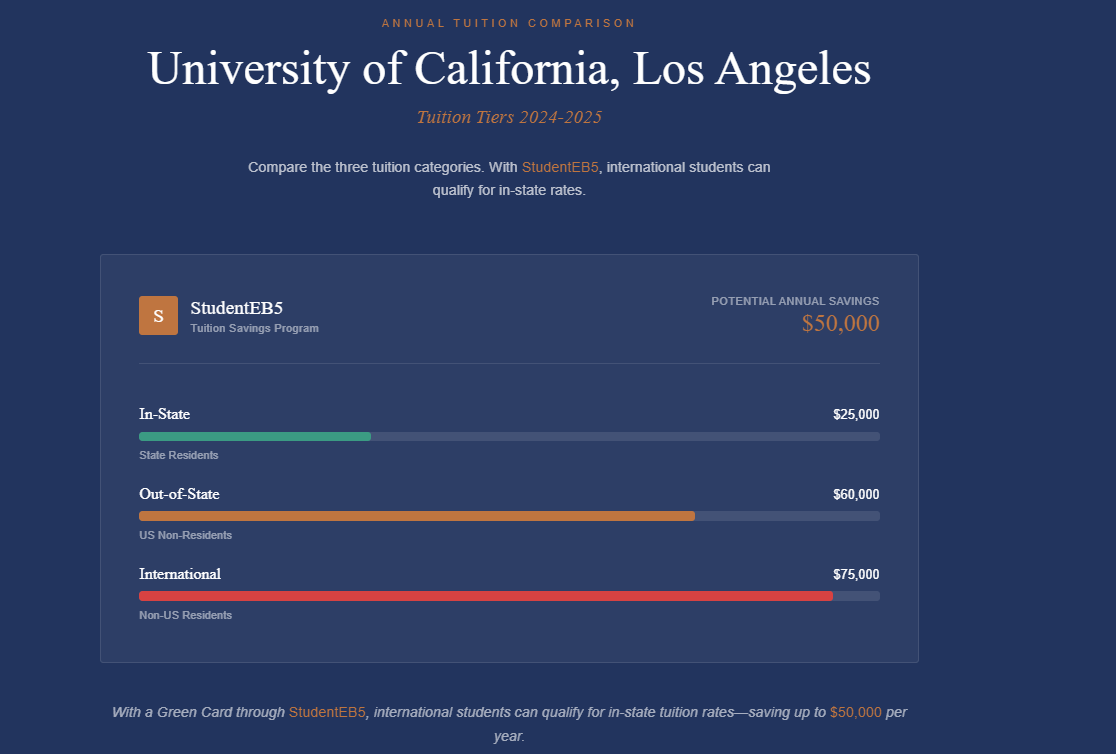
The initial investment is substantial but if successful yields the invaluable return of permanent residency and the return of the investor's capital. International families have already invested heavily in a U.S. education and it may make sense to invest in the EB-5 to mitigate risk and create opportunities for the international student. Learn more about Source of Funds planning.
How F-1 Students Can Finance Their EB-5 Investment
The EB-5 investor must invest capital that is traceable and lawful. The most common ways for students to secure EB-5 capital are through:
Gifts
U.S. immigration allows investors to receive funds as long as the gift is unconditional and the giver can prove the legal source of the gifted capital. To meet the EB-5 requirements the investor must provide a signed and notarized gift deed from the giver and proof of the giver's income or savings. This is a good route for international families who are supporting their student's educational journey.
Inheritance
Inheritance is also an acceptable form of capital for EB-5 investment. To use inherited money the investor must provide a copy of the will, bank statements and proof of how the original wealth was created.
Asset Sales
If the investor owns substantial assets or share in a company these assets can be sold to raise part of the investment for the EB-5. The documents needed for this route include sale agreements, bank statements, proof of original purchase and records of how you obtained the asset.
Personal Income
Students who earned money before coming to the United States can use those savings to complete the EB-5 investment. USCIS typically expects pay slips or income statements, business documents, bank records and tax filings.
Loans
EB-5 allows you to use loans for your investment. If using a secured loan it must be secured by personal assets like property or investments. USCIS requires loan agreement documents, proof the lender's ability to give the loan, evidence of collateral and proof of fund transfer to the EB-5 escrow account.
Conclusion
The window of opportunity for international students is narrow. The stress of the F-1/OPT period is not merely academic or professional. The stress is existential and apart of the flawed U.S. immigration system that treats highly skilled graduates as disposable assets. The low success rates of the H-1B lottery and the short timeframe of F-1/OPT are profound risks for the international student. The EB-5 investment visa creates a predictable path and unique opportunity as a solution. For a detailed roadmap on making this transition, read our comprehensive F-1 visa to EB-5 green card guide for 2026. For international students and their families, the EB-5 represents a chance to remove risk from their substantial investment in their international student.
The opinions expressed on this website are solely those of the author/presenter. The information provided is for general informational purposes only and should not be considered professional or legal advice. Student EB5 and its contributors do not endorse or take responsibility for any actions taken based on the information presented here. Visitors are strongly advised to consult with qualified immigration attorneys and financial advisors before making any EB-5 investment decisions or taking any actions based on the content on this website.
Disclaimer: The opinions expressed on this website are solely those of the author/presenter. The information provided is for general informational purposes only and should not be considered professional or legal advice. Student EB5 and its contributors do not endorse or take responsibility for any actions taken based on the information presented here. Visitors are strongly advised to consult with qualified immigration attorneys and financial advisors before making any EB-5 investment decisions or taking any actions based on the content on this website.
Click to copy a formatted prompt, then paste it into your preferred AI assistant.